Angle of Attack (AoA) Decals
avatar

“Black Ponies and More” 1:32 scale USN & USMC Broncos in the Vietnam War ($22)

It was a bit surreal for me to discover a previously unknown decal maker while on Britmodeller.com forums, then visit the AoA site to see they are practically in my ‘back yard’. I sent an inquiry asking about ordering and proprietor Steve Belanger then struck up a conversation with me.  He then sent along some samples of his sheets even before I had placed my order (for his A-6A Intruder sheets in 1:48 scale.) Totally unexpected, but nonetheless a welcome chance to share the news of such – as I soon found – very interesting and well produced decals with our local modeling community.  Steve seems to embody the enthusiastic, ‘one-man-band’ operation that is becoming so common in the AM decal market. Perhaps it is our generally heightened level of interconnectedness, but many of the decal makers seem to be genuinely interested in opening dialogues with their customers. At one time, we’d take a visit to the local hobby shop to peruse the latest releases but now, much of the effort is collaborative to the benefit of all.  At least, it seems to be the case!

As for AoA’s products, I must say I am specifically impressed on two measures: 1) research and 2) production.

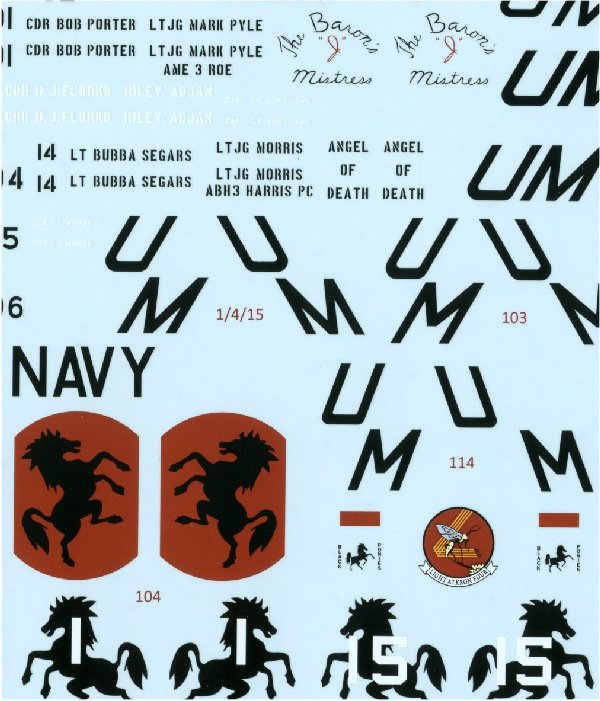
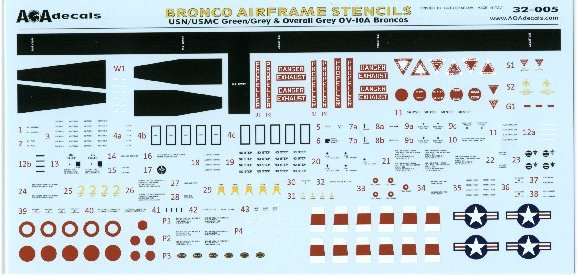
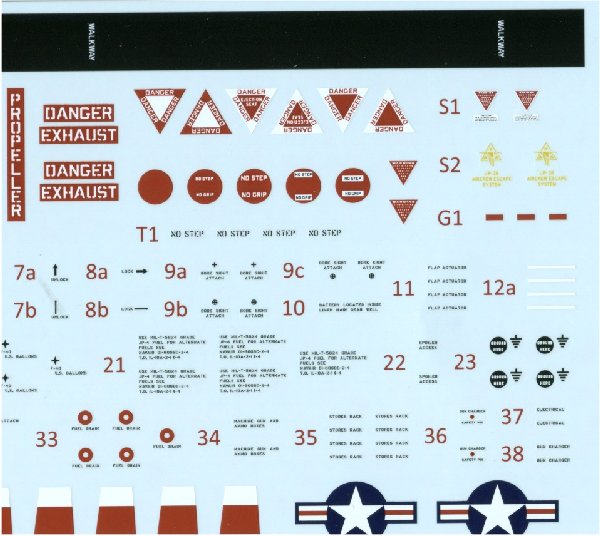
32001_sampleLooking at the “Black Ponies” two-sheet set (one just for the stencils), it has mostly USN VAL-4 birds in green & gray schemes, or overall grey with the colorful VAL-4 ‘rearing mustang’ black horse on a red field unit markings. Also included are a couple from VS-41 ‘Shamrocks’, which acted as the type conversion unit. One VS-41 option is a striking overall black scheme. Plus, one VMO-6 ‘Cherry Six’ USMC bird in green, grey & white scheme. Besides stencils & national markings for one a/c, the individual aircraft numbers and crew names plus any unique markings are all present along with the variations of the propeller, grab-hold & E-seat warnings specific to each aircraft depicted. Plus some helmet markings & sharkmouths for centerline tanks/ guns. Well-researched & with high-quality printing (by Cartograph) of some unique options, the result is an excellent product. Only (admittedly) minor critique being the lack of more USMC choices (somewhat better on the 1:72 sheet with one more of white service markings & ‘Puddy Tat’ artwork) & some difficulty decoding the tiny crew names on the printed profile artwork. I did determine that the crew names are grouped on the decal sheet itself with the associated a/c numbers, so this is easily dealt with once you realize this feature.32004_2_sample The instructions do include two charts: one providing the variations in the prop, E-seat & hand-hold stencils for each aircraft and second an external loads matrix representative of VAL-4 ops. Mention is made of a unique, non-standard centerline 20mm cannon gun pod however no picture or drawing of this is provided. Steve did email me a picture of the pod when I inquired but more research is required if you want to mount one on your model. Fascinating stuff!

A few of the options show the same BuNo at different points in its career, usually differentiated by a color scheme change (11 aircraft in 18 color schemes.)32004_2_closeup

Besides the main sheets, copies of the wing-walk & stencil markings are also offered separately in both 1:32 & 1:72 scales.

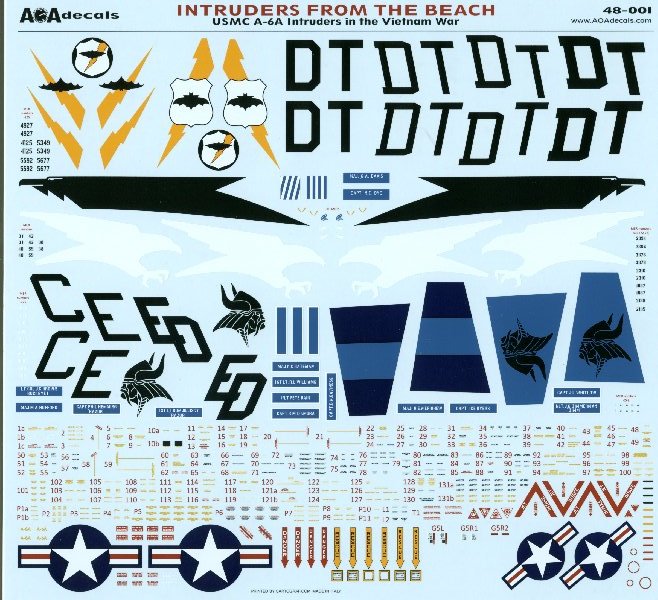
The other AoA sheets focus on USMC A-6 Intruders in Vietnam. The A-6 sheets include full a/c markings plus either one or two (on the 1:72 sheet) sets of stencils & star & bar markings (stencil data sheets are also available separately as with the Bronco sets.) Paper instructions are not included but rather a mini-CD with the some 80 pages of information & graphics again to a very high quality. Certainly a far cry from the one 8.5″ x 11″ single sided instruction of yore!

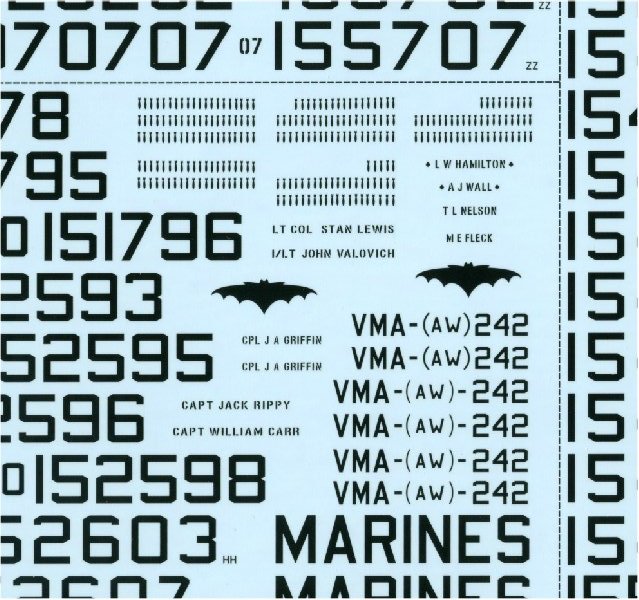
One other note on the Intruder instruction sheet: It is more like a markings research thesis than decal instructions. 48001_2_sampleIncluded is information on ‘converting’ the HobbyBoss A-6 kit to the correct configuration for the markings options provided, followed by very specific data on nearly every airframe flown by the three squadrons covered (VMA(AW)-225/242/533) including the various minor & not so minor differences.

Other sheets I examined included:

  • 48-001 / 72-001 – Intruders from the Beach (USMC A-6A Intruders in the Vietnam War)
  • 48-002 / 72-002 – Intruder Airframe Stencils (Hi-Vis) for A-6A, A-6E, A-6E TRAM & KA-6D
  • 72-003 – Black Ponies & More (USN/USMC OV-10A Broncos in the Vietnam War Era)

As is apparent, the subject list is as of yet restricted to Intruders & Broncos, but Steve has posted his intentions on the website for USN/USMC A-4 Skyhawks in 1:48 & some weapons stencil sets in 1:32. I expect these will be similarly well produced.48001_1_sample

Ordering is directly from the website where all sheets are fully described with images that show the product clearly, so there is no doubt what you’re getting.

Posted in Reviews | Tagged , , , ,

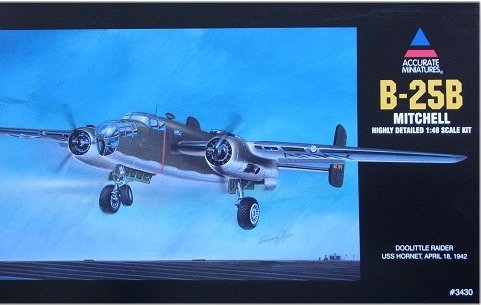
Accurate Miniatures 1/48th “Doolittle Tokyo Raid” North American B-25B Mitchell
avatar

AM_3430_B25 DoolittleI obtained this kit (#3430) soon after its release in 1999.  Construction, however, was finally started in January 2012.  Overall, the kit was excellent, but it had a few inaccuracies.  In a nutshell, the B-25 Mitchell had a glorious, historically significant career.  However, most of the B-25’s contributions to WWII were via later variants – the B-25C/D, B-25H and B-25J.  Of the over 6600 B-25’s built, only 120 (119 delivered) of them were the early production “B” model used for Jimmy Doolittle’s famous “Tokyo Raid”.

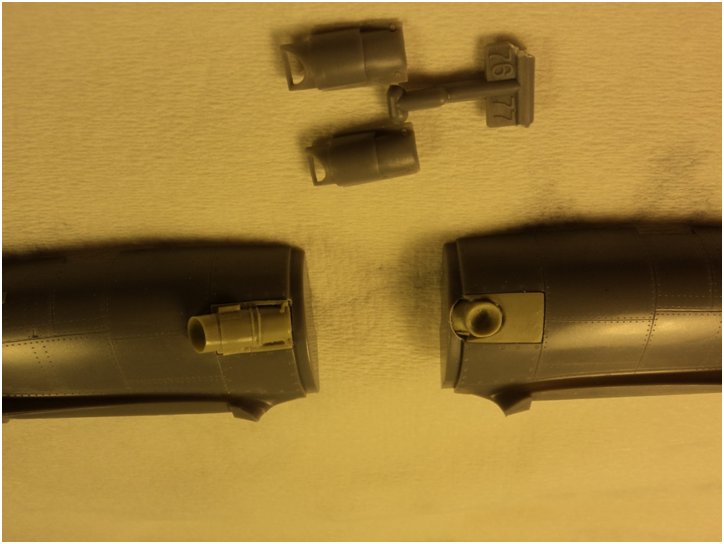
Construction & Correction:  Unfortunately, the Accurate Miniatures kit is closer to a “C/D” variant so, I had some corrections to do in order to make it into an accurate “B” model.  An excellent source of aftermarket parts for this kit was found at Bruce Radebaugh’s Parts R Parts.  I used resin parts procured from the Parts R Parts website for the following:exhausts replacement

  • Replaced the kit’s exhaust pipes.  Early B-25s had a long exhaust pipe on the port engine, and a short stubby one on the starboard engine.  The supplied kit parts were identical parts for both sides, and they didn’t come close to what either exhaust pipe looked like.
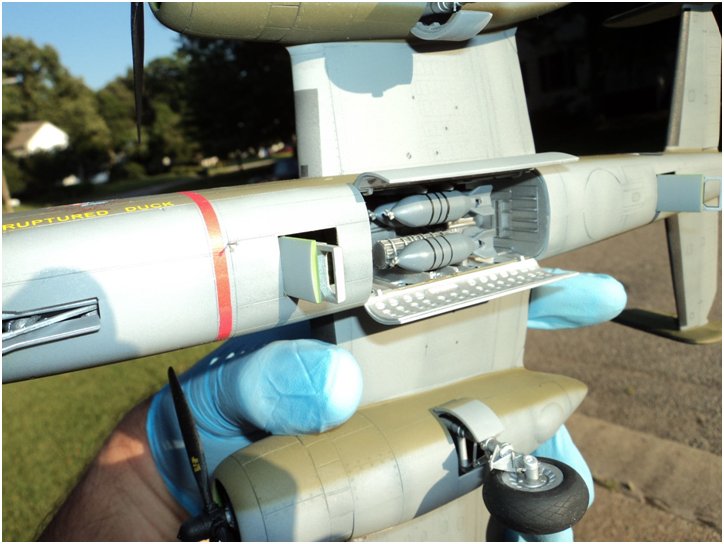
  • Installed a 60 gal fuel tank in the place where the aft bottom turret was removed.  This was a modification to all aircraft used on the Doolittle Raid.
  • Installed a 500 lb incendiary bomb.  Plane #7, like most of the other planes in the Doolittle Raid, carried three 500 lb general purpose high explosive (HE) bombs and one incendiary bomb.  The kit just gave you HE bombs.  If you want to build LT Col Doolittle’s plane, you’ll need four of the incendiary bombs.
  • Replaced the kit’s cowl flaps and upper cowl scoops with the much more accurate resin parts.replacement cowling n intake

I had also procured and used a set of out-of-production Cutting Edge corrected engine cowlings, designed to replace the incorrect kit parts.  The too small engine cowling opening also could have been easily fixed by opening the front of the cowlings a bit using sandpaper wrapped around a dowel.  Other corrections to the kit included:

  • Port & starboard wing tip mounted navigation lights were molded to represent later variants of the B-25.  I sanded those off and installed new navigation lights in the correct position for a B-25B.  I used leftover clear parts from a Hasegawa P-40E kit.
  • Added a light to the upper fuselage, just forward of the direction finder.
  • Air-to-ground signal lights were molded into the bottom of one of the wings.  These were not present in early B-25s so I filled in these lights.
  • Outboard fuel caps were molded into the wing tops & these also were not present in early B-25s.new bombsight
  • Removed fuel vent pipes molded in the rear of the engine nacelles.  Again, a later feature.
  • The kit provided a part for the Norden bombsight which was removed from the Doolittle Raider aircraft for a couple of reasons:  1)  We didn’t want them falling into enemy hands, & 2) the sophisticated Norden bombsights were ineffective at low altitude (bomb runs for the Raid were at 1500′.)   The Norden was then replaced with a simple aluminum “sighting bar” that better facilitated low altitude bombing.  This ad-hoc bombsite was called a couple of names: “Greening Bomb Sight” (after the person who designed it) & the “Mark Twain” bombsight.  Anyway, I scratch-built this bombsight out of Evergreen plastic.new cooling gills
  • To represent an armor fuselage reinforcement plate aft of the upper turret, I painted decal paper, cut it to shape and applied it.
  • Added ‘fake’ gun barrels to the rear gunner’s position per the kit instructions (not really a correction but should be noted.)

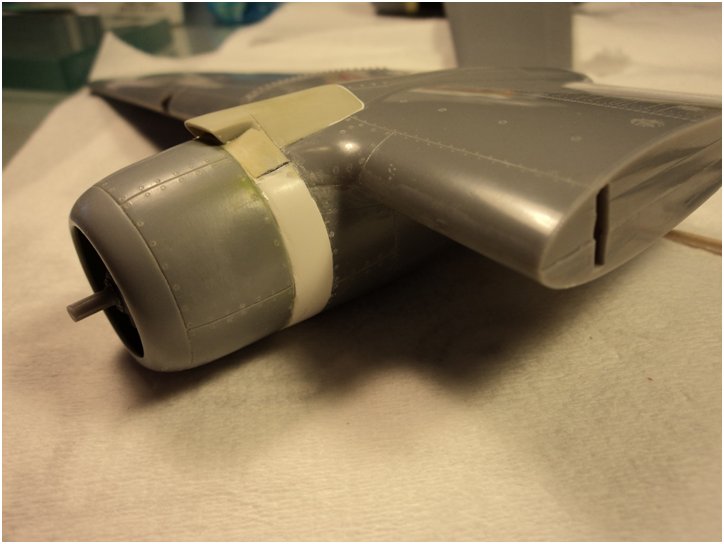
I did have one major fit issue with the starboard nacelle-to-wing joint.  While half of the nacelle to wing joint was fine, the other half had a major step.  I used a large dollop of Milliput epoxy putty to fill in the step, smoothed out while it was still wet and once dry, I sanded it before I re-scribed the cowl flaps.

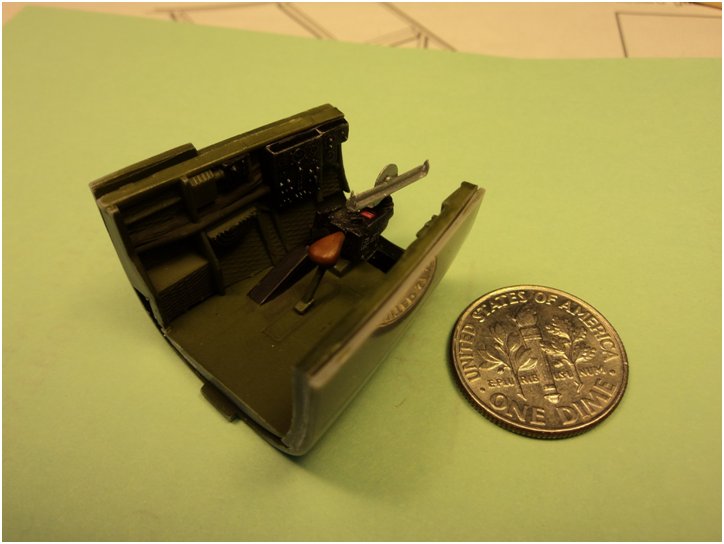
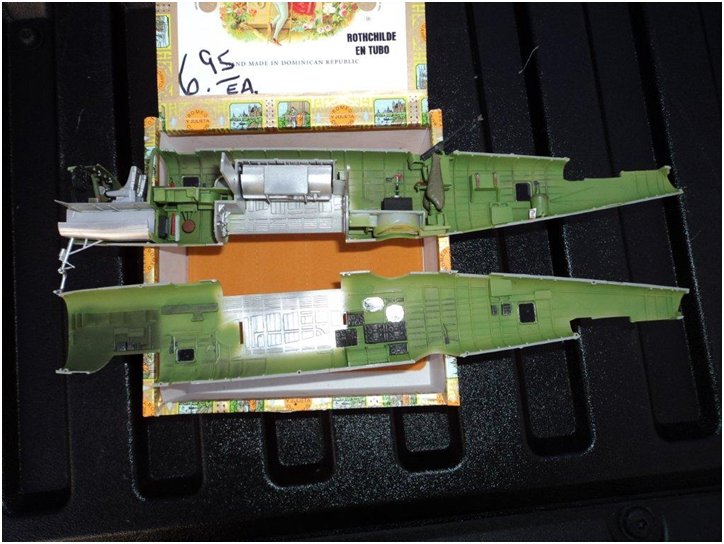
interior built n paintedPainting:  I did a lot of research to verify the correct interior colors.  The interior of most WWII aircraft was predominantly “zinc chromate green”.  The kit directions called out a lot of aluminum and dark green within the interior.  As it turns out, the directions were pretty accurate.  The aluminum color actually represents a clear corrosion preventive that was impregnated with flakes of actual aluminum (aka ‘leafing aluminum’), then applied as a paint.  This ‘aluminum’ is the color of the bomb bay and wheel wells.  The flight deck and bombardier section of the plane was painted dark green at the factory.  (The model has a very nicely detailed interior which unfortunately is mostly not visible. bombbay shot However, it is all in there and you can see it in the pictures.)

For the exterior, I pre-shaded the panel lines with black before applying the Olive Drab over Neutral Grey scheme top colors plus a lighter shade of Olive Drab on the control surfaces.  The deicing boots were a challenge -lots of tape to mask!  Once the boots were masked off, I painted them flat black.

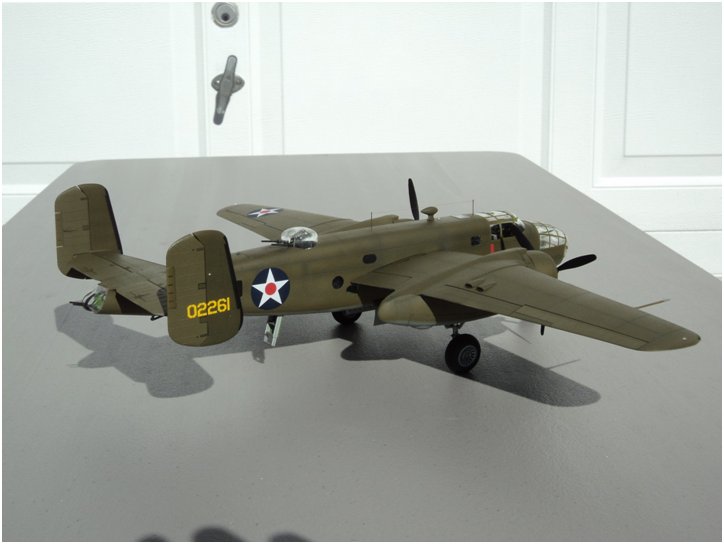
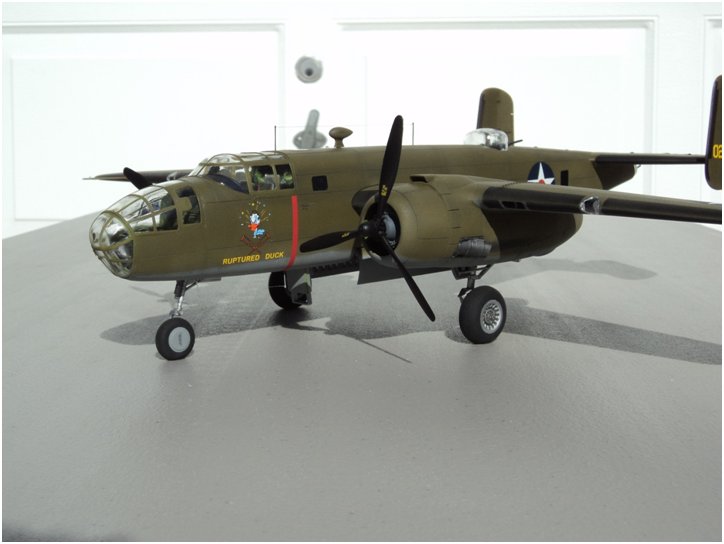
Finishing:  The kit provided decals for all 16 Doolittle Raider aircraft.  I chose to build Plane #7 “Ruptured Duck” because of pilot Ted Lawson’s book “30 Seconds Over Tokyo”, an incredible story of an incredible mission.

finshed 2 Finished 1

Posted in Modeling, Reviews | Tagged , , , ,
Gallery

Winner of Club Build Challenge: ‘Build a P-38 Any Which Way But Loose’
avatar

This gallery contains 16 photos.

The club 2014 Build Challenge was completed on 21 November with 7 entries and two incomplete WIPs available for inspection.  The completed entrants were: Mike Schine – P-38 Lightning (1:48 scale, Hobbyboss) Tom Kean – F-5A Photo Lightning (1:48 scale, … Full Article→

Posted in Club Events, Events | Tagged , ,

Kit Smash! or “Making a mountain from a mole hill” – Pt. 2
avatar

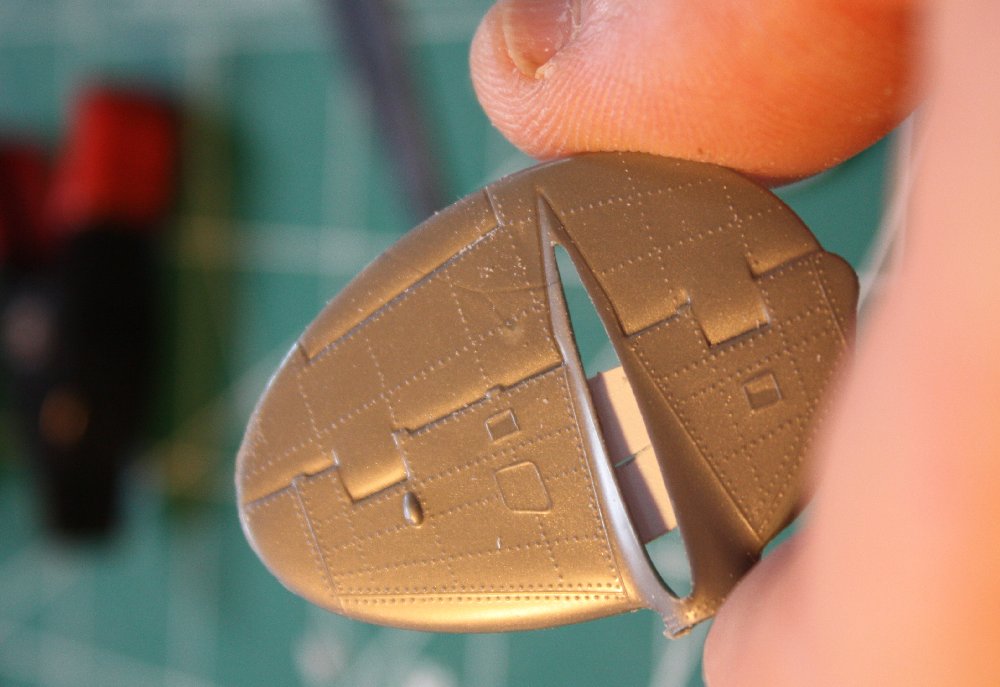
Outer tail half with backer applied *before* cutting off the tail booms

Outer tail half with backer applied *before* cutting off the tail booms keeps proper shape

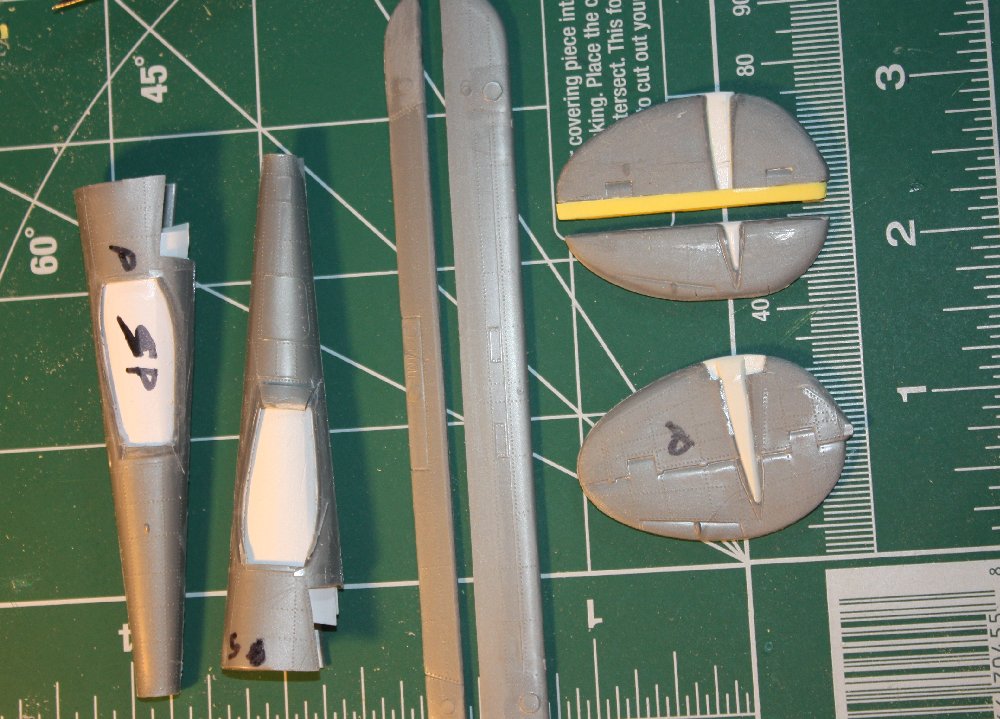
Tail Surfaces:  After cutting apart the P-38 kit’s tail booms, I was left with four vertical tail surface halves, each with good sized gaps to be filled, both from the opening for the horizontal tail and from the trimmed boom connections.

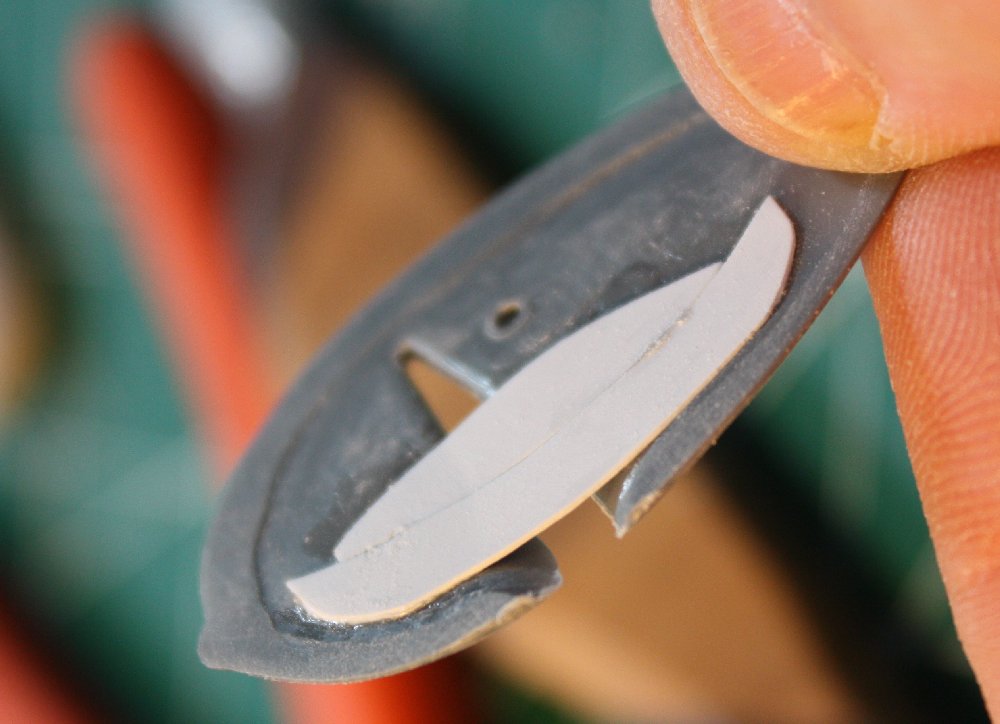
Vertical tail backing plate

Contoured backing ‘plate’ of .010″ plastic sheet applied to inside of part.

trimming the stubs

Trimming the tail boom stubs & leveling the horizontal tail “root fairings”.

These parts I had treated similarly to the wings by applying thin, interior ‘backing plates’ to bridge the gaps and maintain the shape before cutting the tails from the ‘boom portion.

Inner and outer backing sheets

Inner & outer tail halves with backing sheet applied; note different shapes required

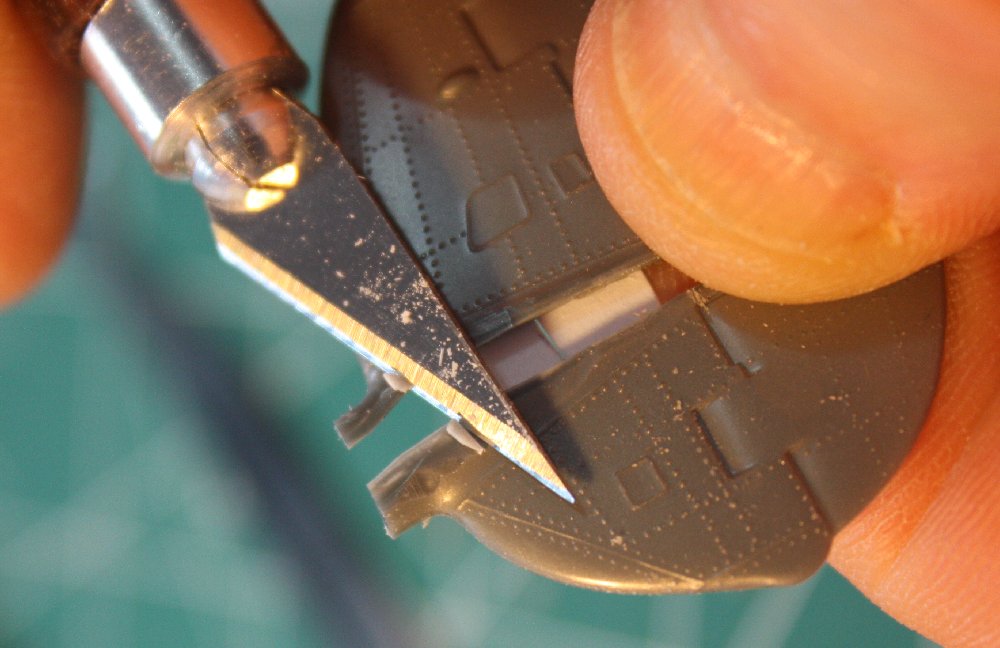
Making a filler wedge

Snapping free a ‘filler’ wedge of 0.40″ plastic

These bits of 0.010″ plastic sheet had to be sized to keep the correct tail thickness when the halves were joined.  (The shapes were determined by trial & error.)

Then I added shaped wedges of thicker sheet to fill the gaps up to the outer surface.  The initial triangle shape was ‘eyeballed’ and scored on 0.040″ plastic & then ‘snapped’ free. Then needed fine tuning was done by scraping with the hobby knife. Once the wedge fit to my satisfaction, it was glued into the gap.  Applications of CA & micro balloons followed by glazing putty would eventually smooth the repairs.

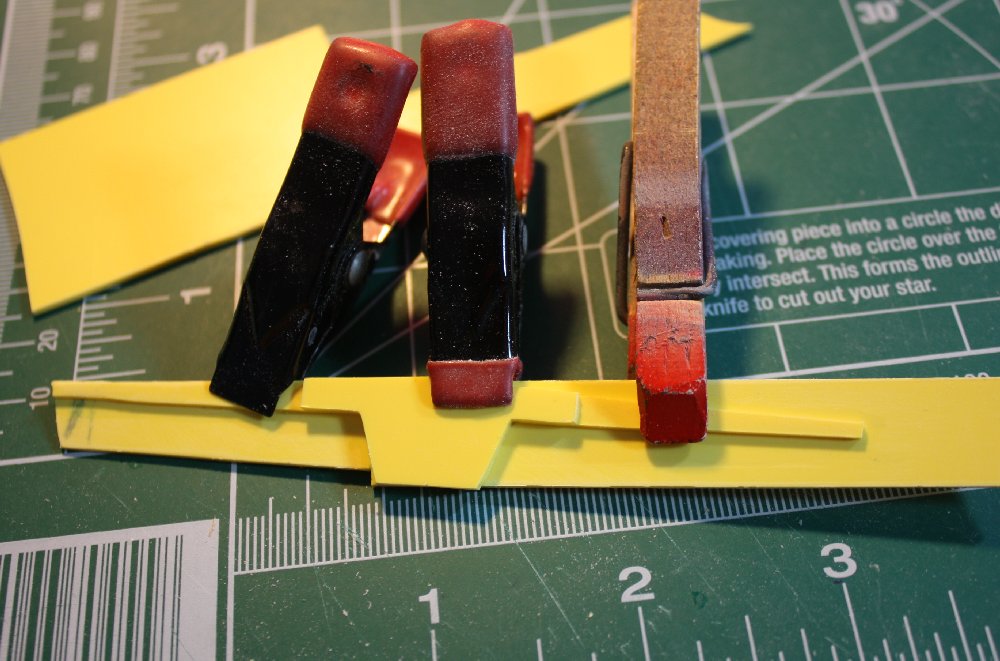
Gluing the wedges

Gluing in the shaped ‘filler’ wedges using clamps

Initial breakdown of tail components

Essential breakdown of tail boom and tail parts after initial surgery & repairs; note the yellow vertical fin ‘plug’.

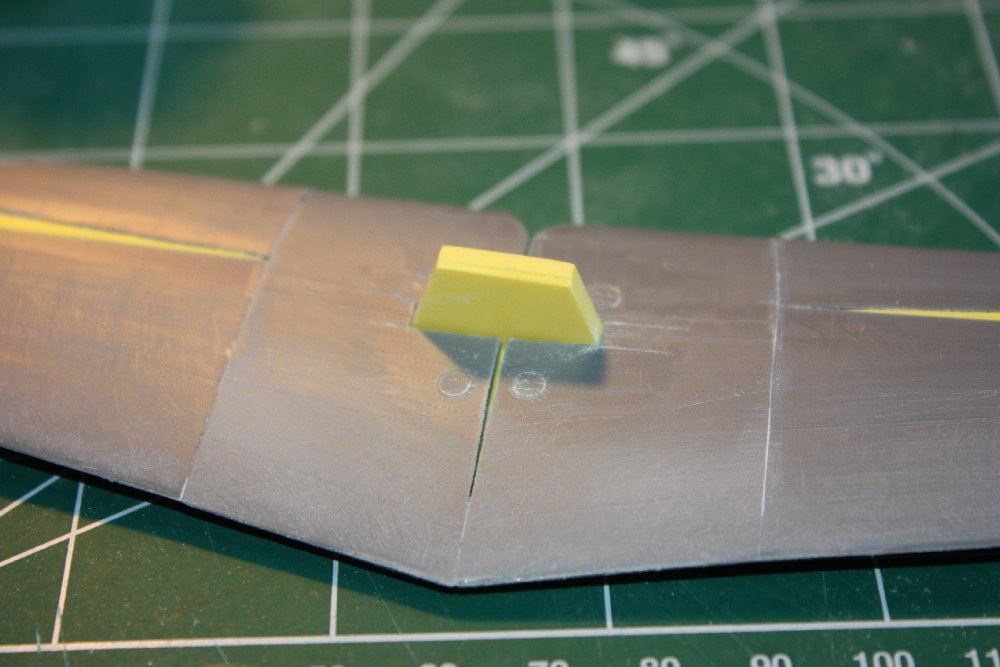
With the gaps repaired, the rudders needed to be cut off the fins so a chord extension plug could be applied to widen the vertical tails. First, the vertical tail halves were glued & clamped together. Then the rudder was cut off at the ‘hinge line’ molded in the parts using a scribing tool followed by the razor saw. The saw was held at an angle so to give a 45-degree cut, creating a bevel on the rudder leading edge. (This reduces the amount of repair needed to form a proper rounded LE.)

The vertical fin plug was made of three strips of basically equal width 0.040″ plastic, layered three deep. The center strip was staggered a bit ‘forward’ so it could ‘socket’ into the gap left from removing the rudder. This made a ‘C’ channel that, when glued to the ‘rudder post’ of the vertical fin gave a ‘socket’ for the rudder to seat into – just like the real thing. The plug joint & the P-38 hinge ‘horn balances’ were then filled in with CA for strength (the new Ki-98 hinge horn cut-out & shaping was delayed until after final shaping & smoothing was done.) A rat-tail file was finally used to thin & shape the edges of the rudder ‘socket’.

Compared to the vertical tail parts, the horizontal tail modifications were simple. The horizontal tail & elevator on the Ki-98 are narrower and not as long as the P-38 so it was a simple matter of removing excess material. I began reducing the chord by cutting apart the elevator & fin, then used another straight score again to remove extra chord from each ‘half’ as needed. Since the exact length of the horizontal surfaces would be determined once the wing and tail booms plus vertical tails were joined, cutting the horizontal tails would have to wait until that assembly was completed. Using a rat-tail file, a seating groove was filed into the fin while the elevator leading edge was rounded off to match.

<Back to Part 1
Posted in Modeling | Tagged , , , ,

Kit Smash! or “Making a mountain from a mole hill” – Pt. 1
avatar

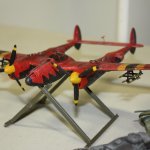
Challenge: Turn a 1/48 scale P-38 Lightning into an experimental WWII Japanese fighter plane.

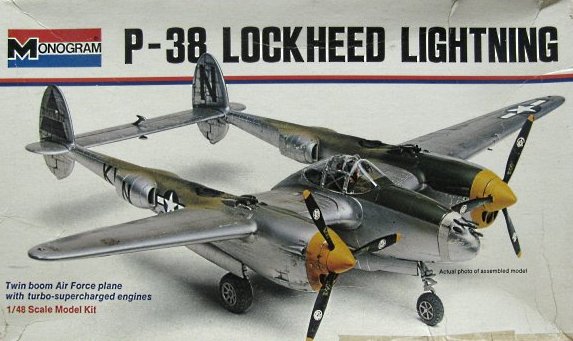
For the November 2014 Club Theme Challenge, we decided to “compete” using any scale or make of P-38 kit, built to any result (in other words, you don’t have to end up with a P-38…)  Because the club had been given a sizable donation of model kits by Mr. David Ekker of Chesapeake, VA & he was a big Lightning fan, we figured everyone would already have a suitable kit of some type on hand just by virtue of various raffles, fund raising sales, etc.  Monogram kit box topI myself selected a nice vintage Monogram 1:48 scale P-38, kit #6848, for my build, as I wasn’t sure I actually wanted to build a P-38 and hence didn’t want to “waste” a more expensive tooling in case things went very wrong. Also, even if I elected to build it as a ‘straight’ P-38, I still thought it would be cool to see just what I could do with the same kit I’d built as a kid (I still remember the ‘apple green’ paint – mixed from square bottle Testor’s primary colors – I used in the gun bay!)
As it turns out, I came across a set of drawings & artwork for the Mansyū Ki-98 while surfing the ‘Web for inspiration.  This was an experimental pusher-prop, twin boom fighter/attack aircraft the Japanese were building just before the surrender, after which the aircraft was destroyed to keep it out of US hands.  The inspiration was how the vertical tails of the Ki-98 looked identical to the P-38’s – something that was borne out once I’d downloaded & printed 3-view drawings (those survived even if the metal didn’t…)  Further comparison with the kit parts showed that I could source most of the tail booms, the horizontal tails, the prop-boss and the wings(!) from the P-38, at the very least.  At this point, “the game was afoot”!Ki98 Experimental fighter
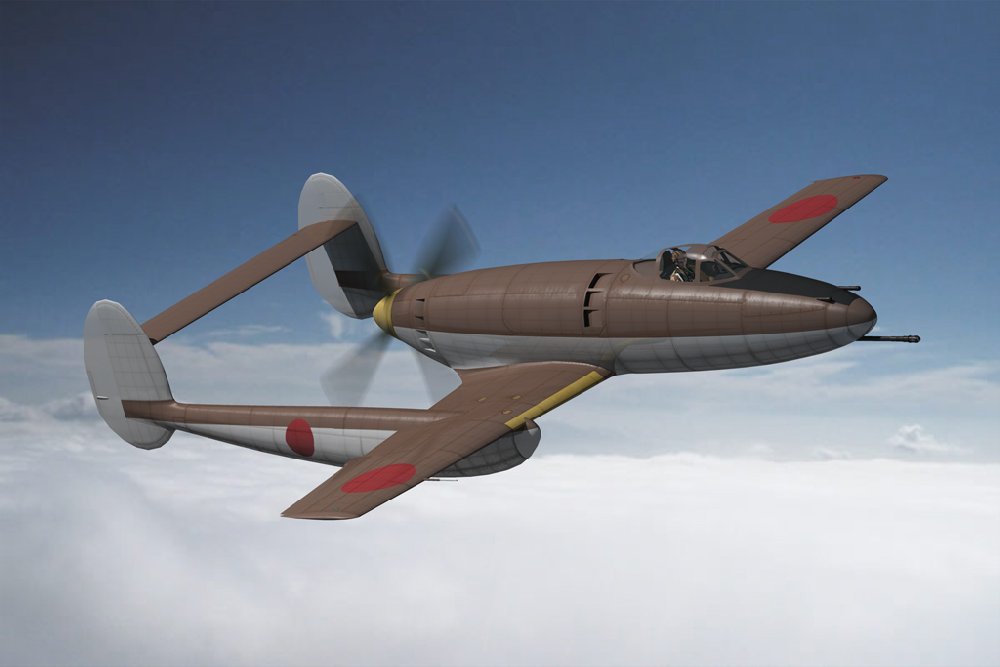
Granted, the P-38 parts were not ‘drop-in’s for the needed components.  Surgery was required on every part but most of the work would be fairly basic ‘saw & plug’.  The main issue was how to make the fuselage.  On the Ki-98, the fuselage was of circular cross-section from stem to stern and contained the guns, cockpit and a ‘buried’ radial engine driving a four-bladed pusher prop (similar to the Kyushu J7W1 ‘Shinden’) via an extended shaft.  This mounted atop a tapered wing that had two underside-mounted tail booms which also enclosed the main landing gear.  A nose-gear retracted into the underside of the fuselage nose.  It featured a concentric array of cooling air intakes and exhaust vents plus an underside mounted turbo-supercharger to adorn the aft fuselage.  Overall, lots of interesting features.  However, nothing from the P-38 kit really could be used for the fuselage pod.  Fortunately, a dig through the ol’ parts bin produced a 1:32 F-4 Phantom center line drop tank (I’m assuming from an old Revell kit) that was almost exactly the right length, width & contour.  The ends, which were very ‘pointy’, required chopping off, but one of the P-38 prop ‘hubs’ was a drop-fit at the rear while the other end would require a replacement nose.  Overall, a very good start!

Wings:  The kit wings were of similar but not exact taper as the Ki-98.  They also incorporated part of the tail booms (top half) & mounting ‘pads’ (bottom) plus the central ‘fuselage’ nacelle halves.  I started by scribing cut-lines (using the great UMM-USA scribing tool) either side of these features, following up with a micro saw (also from UMM-USA) to give me four wing pieces per wing half.  I envisioned re-assembling all these parts into a one piece wing that the center nacelle would mount upon (as appeared prototypical from the drawings.)

Before proceeding further, I ‘scraped’ the outer wing panels’ trailing edges for thinness.  The leading edge was also scraped to reduce the ‘height’, consequently thinning the wing overall.  This was done before any ‘surgery’ because it impacted the actual shape of the wing in plan view (though to a relatively minor degree.)  The center panel parts could wait as those trailing edges would end up changing due to the large chord difference between inner and outer panels.  I also cleaned up any molding defects and alignment pins/sockets from the inside of the wing parts to prevent interfering with later work.
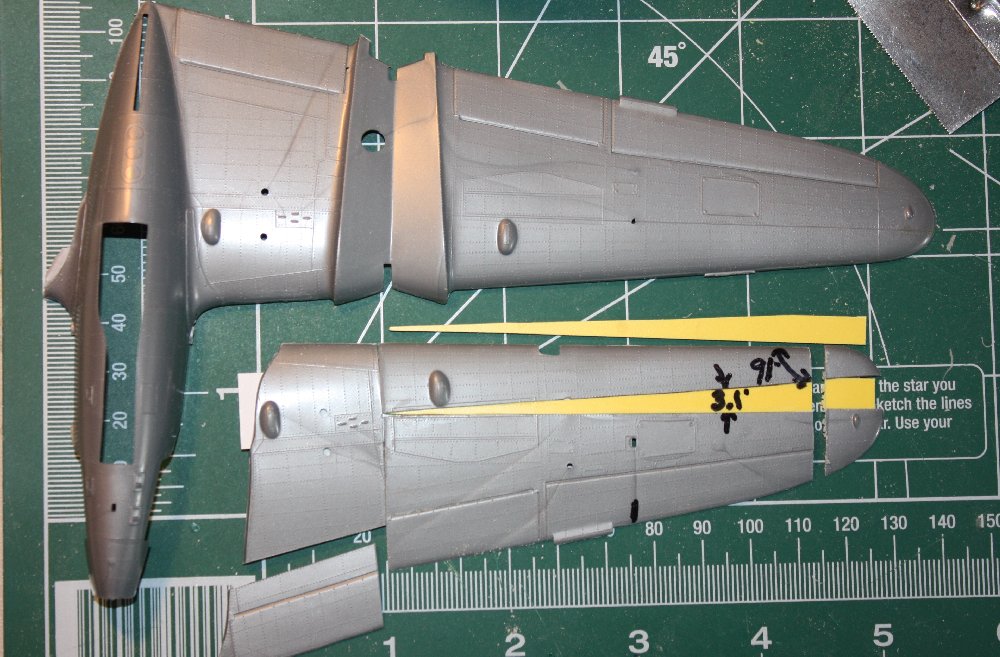
bottom wing on chopping block

Kit wing bottom before and after ‘chop-chop’
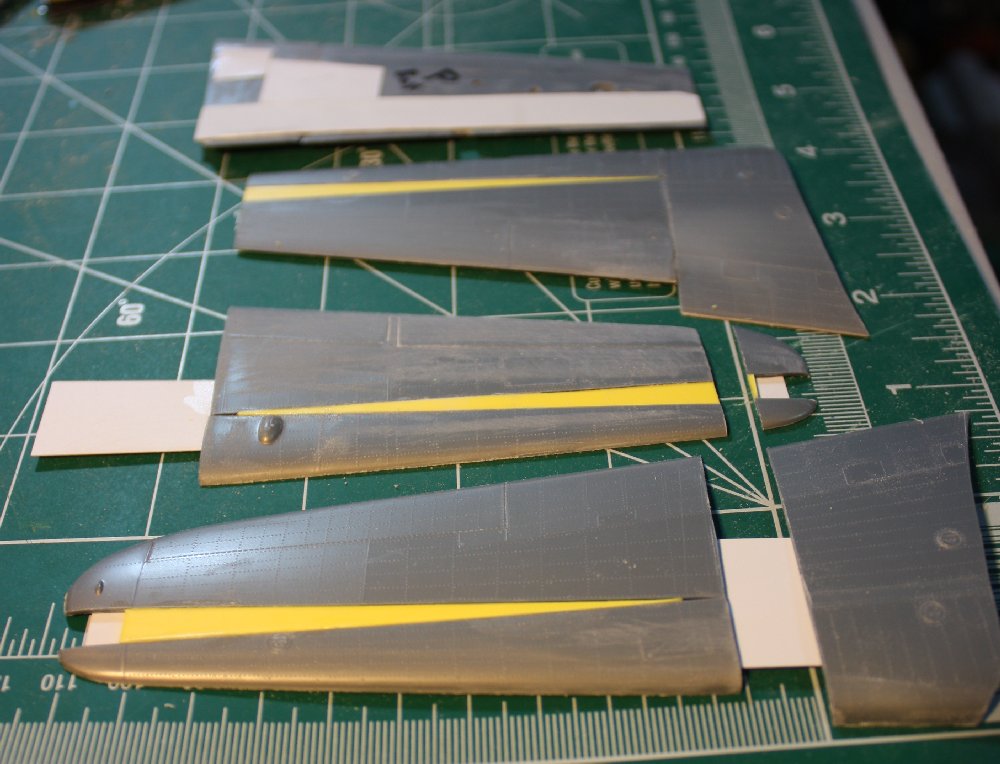
stages of wing assembly

Different stages of wing surgery & re-assembly
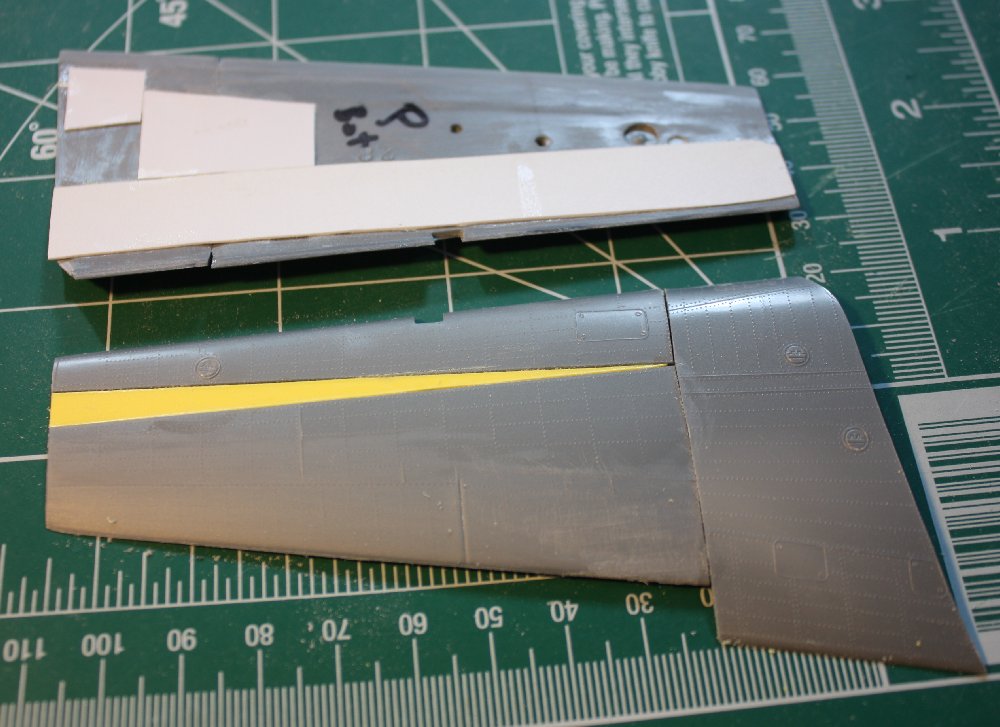
Wing panel wedge & backing sheet
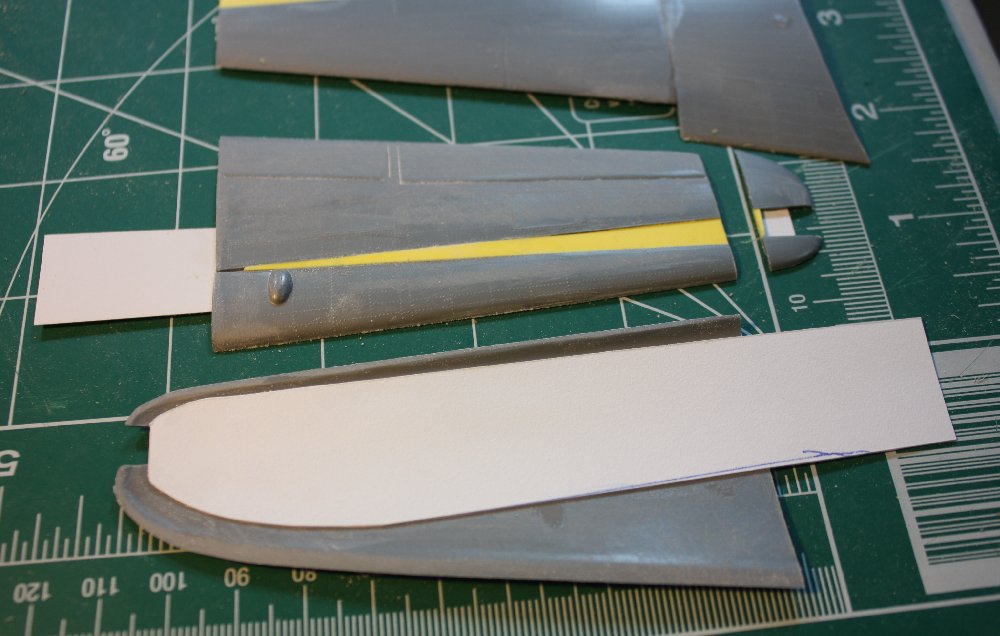
Wing panel wedge & backing sheet

top wing_splice plates

Top wing splice was simplified

wing_spar lamination

Laminating the wing ‘spar’ from plastic sheet
wing_spar assembled

Wing spar installed

wing assembled, underside

One piece wing assembly underside

wing_top assembled

Assembled wing top surface

I started the ‘surgery’ with the lower outer wing, port side.  To correct the taper, I sawed the outer panel in half along a transverse panel line (about where a real spar would have been) to give me a front and rear half to the panel.  Then, laying the pieces on the drawings (which I had confirmed were essentially a ‘true’ plan view instead of a ‘projection’) at a point where the inboard cut matched the chord, I simply shifted the leading & trailing edges to match while keeping the inboard ‘corners’ in contact (in short, the P-38 wing was narrower at the tip than the Ki-98 wing.)  This ‘swing’ separation showed a wedge shaped gap which I marked on the plans and measured the included angle & widest width using a protractor & machinist’s rule.  Then, using the length of the long cut and the angle, I marked the spacer wedge onto .040″ thick sheet plastic.  By marking an additional parallel to the long dimension, I created a rectangle with a diagonal line connecting opposite corners.  This gave me two identical ‘wedges’ to plug the wing corrections on both wings.  In essence, the ‘wedges’ established the correction, not an attempted ‘placement’ to establish a gap that would then be filled.

Then, I used .010″ plastic sheet to make long ‘backer strips’ to glue to the inside surfaces of the two panel halves.  This would bridge the gap and back the ‘wedge’ plug.  These were made long enough to later back the inner panel pieces as well.

I first glued the strip to the leading edge half, after shaping to match the wing tip contour.  Once set, I then placed the wedge onto the backer strip and used that to precisely place the trailing half of the wing panel, applying Tamiya Super Thin cement liberally.  Everything was clamped until the glued joint set overnight.  This same process was then repeated for the other lower, outer panel (using the first panel to check uniformity), followed by essentially the same process for the upper halves, again using the previously completed panels as check ‘templates’.

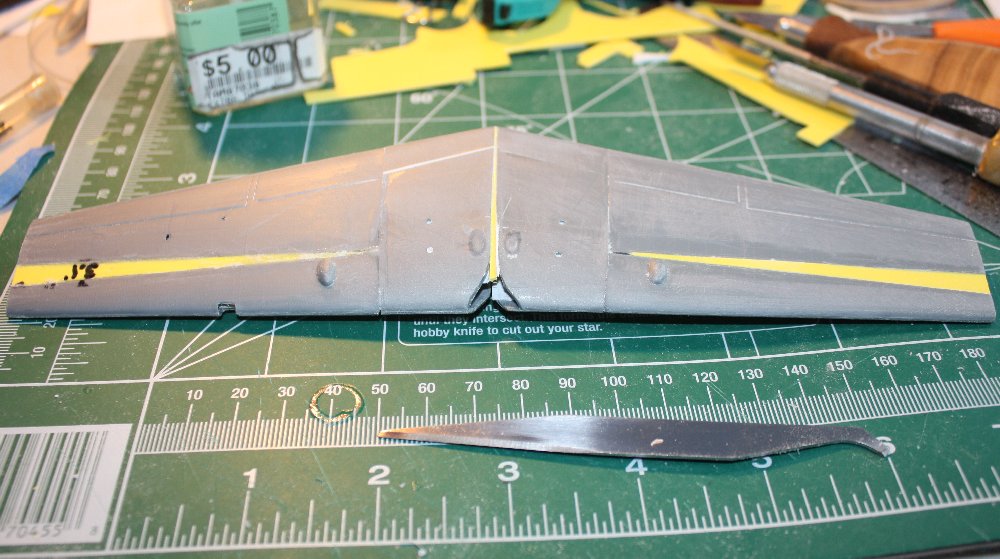
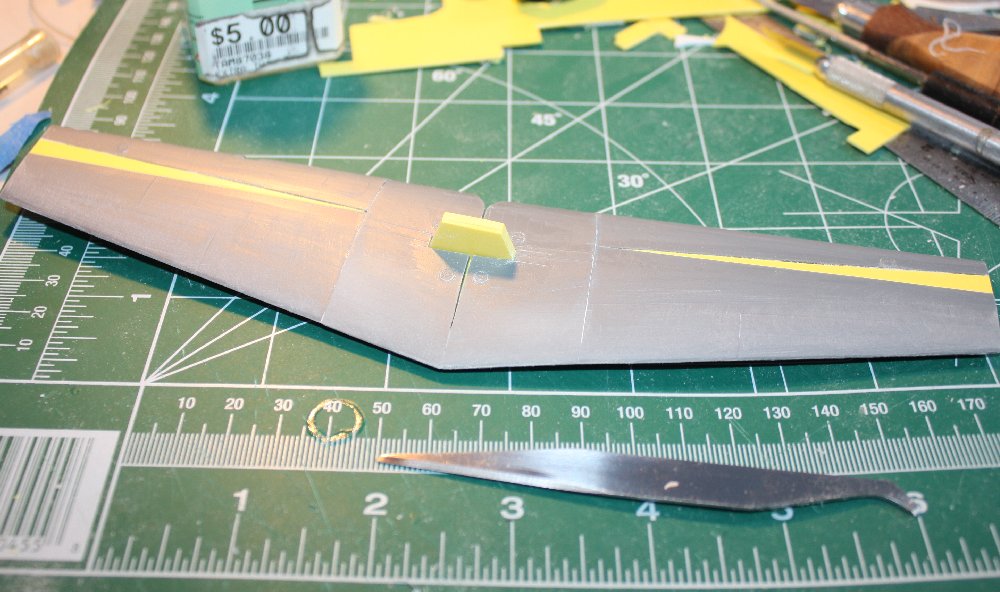
With the four outer panels ‘plugged’ to their new taper, the inner panel pieces (originally between the P-38 tail booms and the center nacelle) were then mated with the corresponding outer bits.  The inner panels required adjustment for the now ‘kinked’ joint as well as for chord width.  Since my backer strips had been made extra long, the inner panels were glued to the strips once the adjustments were finished.  Again, ‘checking’ against paired panels helped keep things uniform and symmetrical left & right.

Finally, once all trimming & tweaking was done, sanding and scraping of the trailing edges was finished in preparation of gluing the top & bottom panels together.   Before gluing, however, the same method of making a ‘prototype’ panel & then copying to the others was used to trim the wing tips.  The Ki-98 had square wing tips, which had already been allowed for when setting the wing chord & taper correction,  so it was simply a matter of mark and saw to remove the rounded tips.

This was done using plenty of clamps applied as close to the edges as possible.  I wanted the leading and trailing edge joints to be well glued to prevent separation when I later ‘sharpened’ those edges by scraping and sanding.

Wing “Spar”:  Laminated from .040″ sheet and slid into the wing cavity between the top & bottom halves, the wing spar would set the dihedral, serve as the primary joint between wing halves and act as the mounting fixture for the wing to the fuselage.  As such, it was very important that it be sturdy & symmetrical.

I measured the dihedral angles from the plans using the bottom wing line as the angle.  I assumed that the bottom wing thickness was basically uniform so the outer surfaces would follow the same angles.  I then adjusted the spar height through a bit of trial & error to ensure a tight fit when the spar was slid into each assembled wing half.  Essentially, by progressive sanding & test fitting, I was able to establish the needed dimensions and the correct placement of the slot I had to cut into the upper wing to accommodate the spar assembly.

Once I had the correct configuration, I laminated an additional two layers of plastic to the sized spar as reinforcement.  This required a further bit of fettling to match the wing interior contours, resulting in a very tight fit.  This was then glued into one wing half, clamped and, once set, was followed by the other wing half.
oil cooler removal

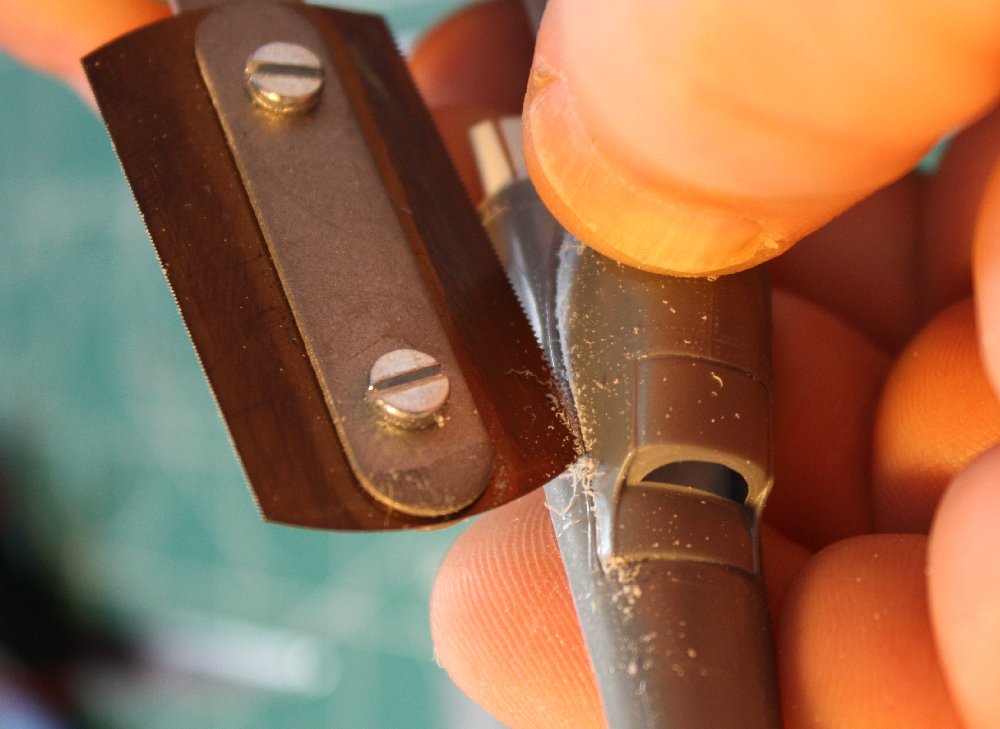
Scribing initial ‘cut’ groove using tip of saw

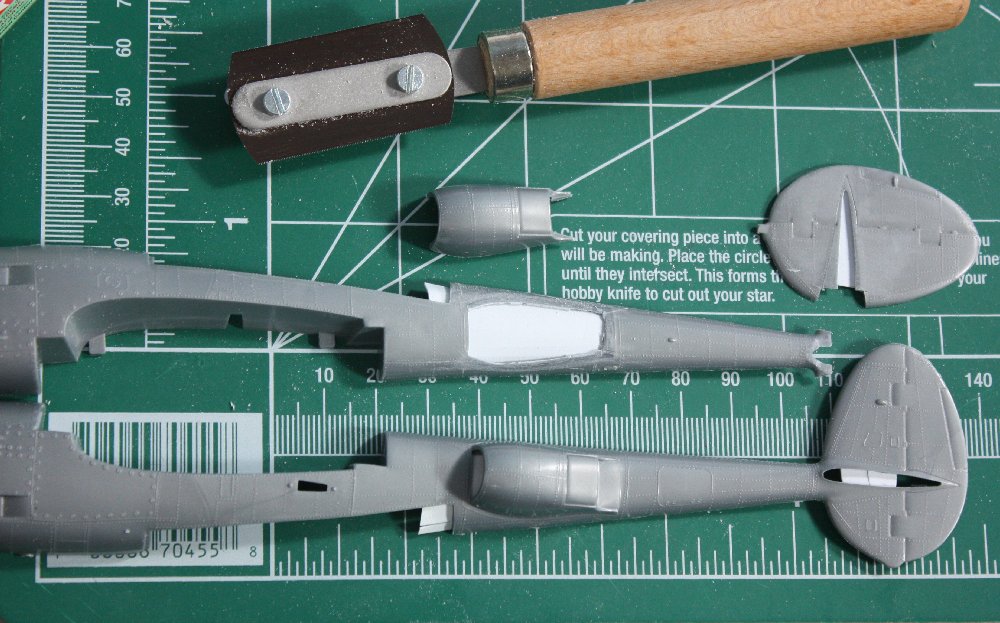
Tail Booms:  The P-38 tail booms fitted the drawings in side profile almost exactly – but were too wide in plan (aka ‘top’) view and continued to widen going forward to mate to the P-38 engine nacelles.  To begin, I first cut the ‘radiator scoops’ from the sides.  This left gaping holes that were then backed with .010″ sheet to support future filling & reinforce the now weakened parts. Then I removed the vertical tail surfaces (required because the Ki-98 tails mounted higher on the booms) & the forward ‘engine’ nacelle sections.  This left just the rear section of the tail boom parts, which were then checked for the excess width.
boom surgery stages

Illustration of the cooler removal (shows backing plastic sheet already fitted before cutting)

This determined the width difference wasn’t uniform along the length as the Ki-98 booms were simply less tapered than the P-38 parts.
To correct the taper, a ‘wedge’ of material had to be removed from the top & bottom of each halves’ edges, being widest at the front & tapering to a point aft.  This had to be done the same on each of the boom assemblies to again preserve symmetry.  So a staged ‘surgery’ sequence was used, similar to that used on the wings.

boom width correction

Sawing off excess boom width “wedge” (note ‘P’ for ‘port’ labels)

First, one outer boom half was adjusted to the correct taper by scribing & sawing off the excess and then ‘dressing’ the new mating edges so they were square.  This was then checked against the plans.  Satisfied, I then held the opposite outer boom part against the ‘adjusted’ part and marked so to remove the same amount of material.  The result was two identical but mirrored parts.  Then the inner boom halves were subjected to the same procedure, starting by sizing one with it’s outer ‘mate’, then using the result to size the “mirror” part.  As the inner & outer halves required differing degrees of correction,  working with the parts as mirrored pairs maintained symmetry.

Next!  Working on the tail…

To Part 2…>
Posted in Modeling | Tagged , , , ,

Applying a Natural Metal Finish Using Aluminum Foil
avatar

Skills Demo presented by Bob Bradford

Bob Bradford presented a demonstration of the technique he uses to apply aluminum foil to his models to replicate the unpainted natural metal aircraft finishes used by many air forces over time. He had two stunning examples in the form of a 1/72 scale MiG 19 (from the KoPro kit) and a 1/72 scale Saab J29 (from the Heller kit). These were finished in a combination of foil and metalized silver paints and presented a very effective illustration of just how effective foil can be. Bob’s detailed notes & diagrams were distributed to the club and are available HERE. However, it is worthwhile to summarize his explanation here as a general overview.

Bob begins with why he uses foil for natural metal finishes (NMF) such as used on USAAF aircraft at the end of WWII and most Soviet and USAF types during the ‘Cold War’. Simply put, he feels nothing looks quite like aluminum as the real thing!  Of course, he cited other uses such as chromed metal on automotive subjects, commercial airliners and even figures where ‘metal’ effects are needed (such as polished armor.) He also indicated that metalizer-type paints are also useful in combination for complimentary effects but nothing provides the subtle “grain” and reflectance of foil.  So, for him foil is superior even though, as he put it, “requires ten times the work!”

To create a natural metal finish using either foil or paint, both start out the same with as near-perfect a surface as possible. Since both methods use thin ‘overlaid films’ (on the order of .001” thick), foil is not any more forgiving of surface defects than the typical NMF “paint system”. However, foil requires more planning since much of the foil application is best done to sub-assemblies and not the completed model, due to the higher degree of handling required.

Planning accounts for much of the effort when foiling. To start, Bob pointed out that the layout of the panels must be organized and sectioned for efficient & effective foiling. He referred to minimizing seams but also balancing this with the appropriate number of sections over areas of compound curvature to combat wrinkling. Whenever possible, seams should fall on a panel line – and often do since aircraft especially are skinned subject to similar but larger considerations! From this analysis, a ‘section map’ is created using a suitably detailed 3-view plan (copies from the instructions are handy if detailed enough.)

Part of the analysis concerns panel coloration. This needs careful examination of reference images (both B&W and color) to see how reflectance & ‘hue’ of the individual panels are arrayed over the airframe. This is annotated on another copy of the 3-view to organize the various treatments, including use of metalizer paints as needed. ‘Grain’ orientation is also noted since this can be used on the model to help make the finish more realistic.

Once the panel & section maps are developed, then the application sequence must be decided. The general idea is to work one panel at a time, from ‘inside’ areas to outer, or from one side to another, always with the next panel being adjacent to the prior. In effect, each panel is defined by where & what it ‘looks like’ & when it is applied – all before cutting the first piece of foil.

Actual method of application involves first removing an easily handled piece from a roll of kitchen foil(!)  Bob prefers kitchen foil since it tolerates ‘man-handling’ better, with “heavy duty” foil being even thicker than the usually quite sufficient ‘regular’ foil. Cost aside, Bare Metal brand self-adhesive foils are much thinner and not as suited for NMF because it tears more readily. Instead, Bob uses Microscale brand foil adhesive to secure the foil. He first cleans the foil as well as the model with 91% isopropyl alcohol and then applies the adhesive using a medium-sized soft, flat brush, working it carefully to prevent brush marks or unevenness, since such may show. Bob uses the etched side of the foil (aka ‘the dull side’) to apply the adhesive as it provides a better mechanical ‘tooth’. Once set per the bottle’s instructions, he can then cut a slightly over-sized section using scissors as needed.

Per the section plan, he then uses a low-tack masking tape to precisely ‘border’ the panel to be foiled.  (Best to cut off the tape’s ‘factory edge’ first.)  Then the foil is lightly placed in position, overlapping the tape & adjacent panel.  Then cotton buds are used to burnish the foil, working from the center to the edges (but not onto the overlap), working carefully to avoid wrinkling the material. Once burnished, the excess is cut using a new #10 Xacto blade (new because any dullness will tend to ‘tear’ the foil), using a rocking motion to cut the overlap along the adjacent panel edge & masking tape ‘guide’. When the edges are trimmed and the tape removed, the seams are then finished off using further burnishing, a light sanding with a foam backed sanding stick and fine steel wool. The aluminum foil will actually accept some ‘stretching’ and blending due to it’s relative thickness (which Bare Metal will not, being it is ~ .0005” thick.) The foil adhesive takes quite a few days to fully set since it actually is evaporating from under the aluminum via the seams – obviously a slow process. In the meantime, a panel can be removed and redone if damaged. However, over time, removal becomes much more difficult.

Grain & coloration is then addressed, initially by ‘polishing’ the entire foiled assembly in the primary grain direction’ using steel wool. The individual panels can then be ‘grained’ according to the ‘grain map’. The foil itself has a natural grain, of course, that can be oriented as desired to induce contrasting or complimentary reflectance as needed. Alternative grain (say, on a diagonal) can be induced in the foil prior to application of the adhesive as well.

For coloration, Bob unusually takes advantage of clear and tinted overcoats to alter the appearance of the NMF. He noted that real aircraft generally are not as ‘shiny’ as the foil appears on the model. Hence, flat or satin clear coats can make the model more realistic by simulating oxidized aluminum & other wear. Clear tinted overcoats, while admittedly needing more experimentation on his part, was seen as a way to replicate heat “aged” panels and panels made of metals than aluminum. Bob’s philosophy is to achieve a finish that matches the ‘real world’ appearance rather than merely ‘shiny metal’ which tends to look toy-like & monochromatic, especially in smaller scales.

Bob’s full demonstration provided much more detail such this write-up only provides a quick overview. His full notes provides examples of Bob’s planning maps (which are of course reusable), material lists and additional details (such as using toothpicks to emboss rivet and panel line details).  He showed that achieving an effective natural metal finish isn’t magic but rather, when tackled in a methodical and logical fashion, can – without a doubt – provide ‘astounding’ results.

[Some other articles on NMF techniques can be found on the web at the following sites (as of 27 Oct 2014):]


Posted in Technique | Tagged ,

‘Build a P-38 Any Which Way But Loose’ – Club Theme Event
avatar

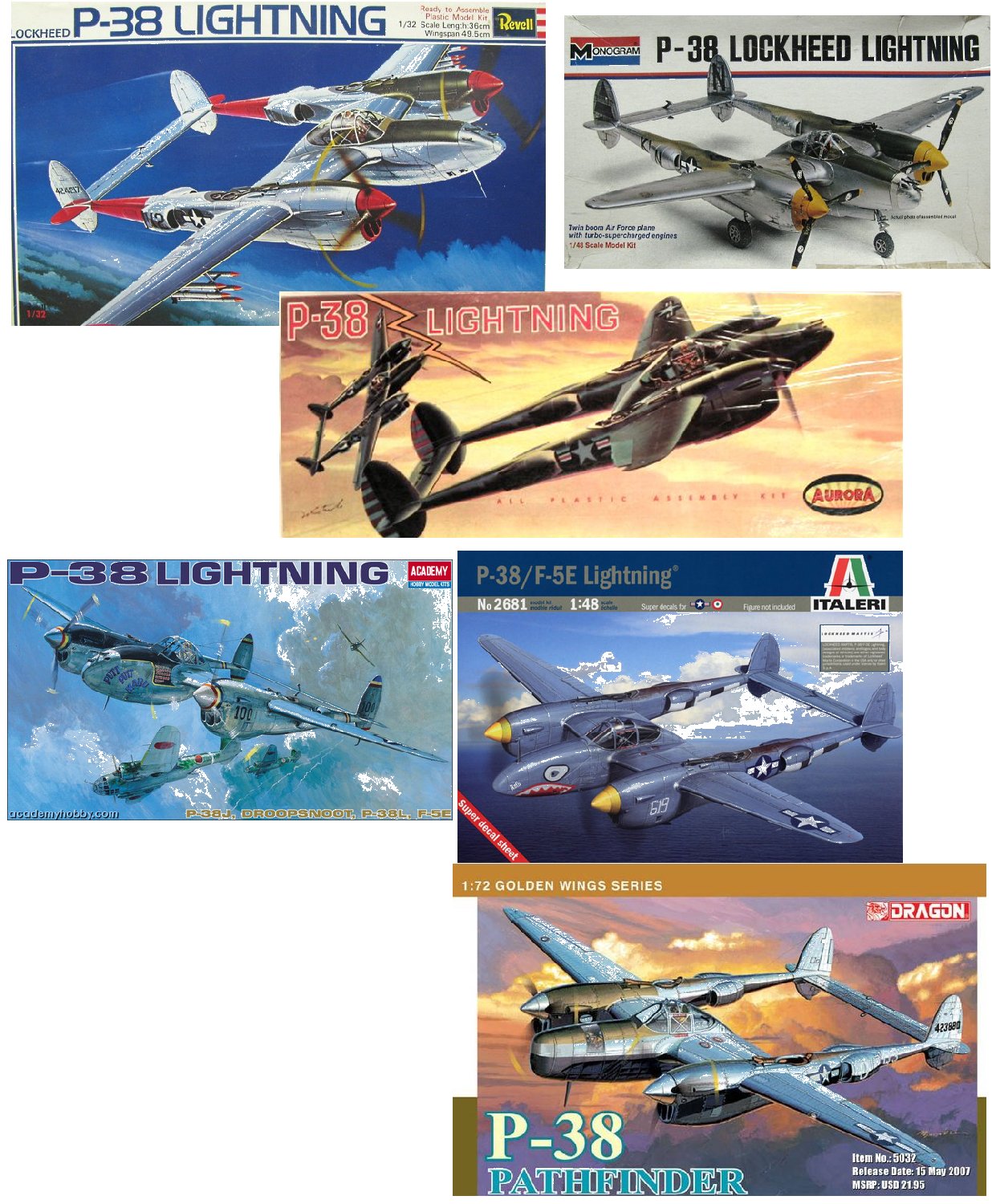
At the November meeting, the club will host a themed display of models, all constructed from the same basic starting point: a kit of the P-38 Lightning fighter aircraft of World War Kit box compilationII fame.  What the builder makes of their kits is up to them so several decidedly ‘non-airplane’ results are expected to be on show.  There is no restriction of which ‘P-38’ kit is used, other than it has to be of a Lightning (instead of the other possible ‘P-38’ subjects…)  Hopefully, such a ‘loose’ structure will fan the creative flames.

As such, the true theme of the event is to build, have fun and work outside one’s normal ‘comfort zone’.  Similar events have been held in the past but it has been awhile which probably motivated member Skip Paetz to propose the group build.  The subject choice was driven by the kind donation of a large number of models by David Ekker of Chesapeake, who is a big fan of the Lightning (and consequently provided a whole box of P-38 kits.)  In a way, this is one way to say again “Thanks!” for his gift.

Not strictly a competition but more of a “beauty contest”, the most popular entry will garner the builder a $25 Gift Certificate from the VA Beach HobbyTown USA store.

Posted in Events | Tagged ,
Gallery

HobbyTown USA (Newport News) – Shop Report
avatar

This gallery contains 15 photos.

A relative newcomer in the Northside area hobby market, the Newport News HobbyTown USA store has still been located in the Denbigh Crossing Shopping Center for at least eight years after leaving an original location on Warwick Blvd.  Fairly standard … Full Article→

Posted in Industry | Tagged
Gallery

Denbigh Hobby Center (Newport News) – Shop Report
avatar

This gallery contains 16 photos.

An example of the ‘classic’ Local Hobby Shop (LHS), family owned & operated Denbigh Hobby Center is located in Newport News, VA and has been in continuous operation since 1976. Located in a corner storefront nearby to the Big Lots … Full Article→

Posted in Industry | Tagged
Gallery

Ed’s Hobbies (Closed) – Shop Report
avatar

This gallery contains 30 photos.

UPDATE 2 October 2014: Sad news, Ed has closed his shop as of the end of September, 2014. [originally published 6 August 2013]: Recently opened in the Red Mills Commons shopping complex by owner Ed Dalton is “Ed’s Hobbies“, where … Full Article→

Posted in Industry | Tagged | 2 Comments